
The Evolution of X-Ray Quality Control with AI-Driven Verification
The electronics manufacturing industry is experiencing unprecedented expansion, driven by the rising demand for sophisticated devices across multiple sectors. According to IPC, this demand is projected to propel the market from approximately $534 billion in 2023 to $856 billion by 2030. However, this rapid growth is accompanied by a severe labor crunch. The US alone risks a technician shortage reaching 90,000 by 2030, according to Bloomberg, while Natcast forecasts that the broader semiconductor industry will be unable to fill more than 67,000 projected positions.
To bridge this gap and manage the escalating complexity of modern printed circuit boards (PCBs), the industry is aggressively turning to artificial intelligence. Data from the Market Intelligence & Consulting Institute (MIC) indicates that nearly 65% of companies in Taiwan have invested in AI, with up to 57% adopting AI-enabled optical inspection solutions. While AI has rapidly transformed surface-level inspection, its integration into Automated X-ray Inspection (AXI) represents the next crucial frontier for ensuring the reliability of hidden solder joints in densely packed assemblies.
Current PCBA and X-Ray Inspection Challenges
X-ray inspection is inherently noisy, making the interpretation of complex grayscale images a difficult task. As PCBs become more complex with high component densities and fine pitches, traditional systems often force a trade-off between inspection depth and false call rates.
· The “Gray Area”: Distinguishing a fatal Head-in-Pillow (HiP) defect from a benign shadow frequently generates many false positives, reducing production efficiency and increasing unnecessary rework.
· Operator Fatigue and Inefficiency: Traditionally, operators must manually review thousands of these images, leading to escapes or the scrapping of good boards. Typically, repair station operators perform poorly under these repetitive conditions, and manual training is not cost-effective.
· Complex Programming: Setting up AXI systems for high-mix, low-volume production requires significant expertise and time, creating a bottleneck before inspection even begins.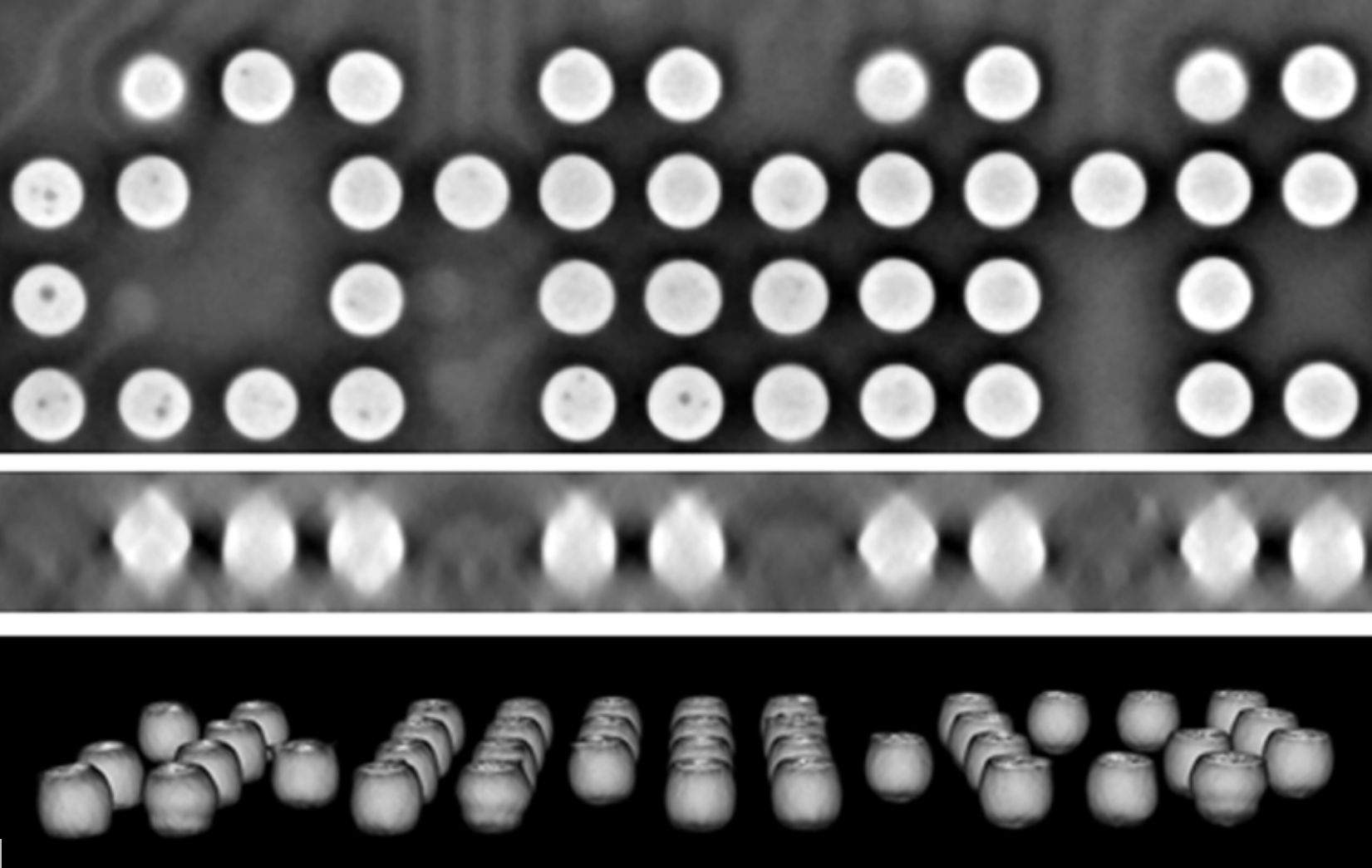
AI Technologies Addressing X-Ray Challenges
By leveraging neural networks trained on vast datasets of PCB images, AI-powered systems can analyze visual data with unprecedented accuracy. To translate this precision into actual factory efficiency, TRI engineered the AI Verify Host specifically to automate the traditional “Buy-Off” process. Operating as an intelligent repair station, it significantly reduces the need for manual re-inspection and lowers operational costs. The AI-powered repair station can continuously operate efficiently, outperforming human operators while lowering false calls and providing real-time data analytics of the inspection status.
To achieve this reliability, especially in intricate X-ray analysis, TRI employs a multi-model architecture:
1. AI Detection (Object Localization): The first line of defense scans the X-ray image to rapidly identify “Regions of Interest” (ROIs). Thanks to TRI’s AI verification advancements, the detection rate of components has improved significantly. The AI detection accuracy for general chip defects now exceeds 99%. Specific improvements include a detection rate of over 95% for components such as OSC, MLD, SOD, SOT23, RNET, and CNET.
2. AI Segmentation (Precision Measurement): Crucial for X-ray void analysis. Operating at the pixel level, this model traces the exact contours of a void or a solder bridge. X-ray void detection with AI implementation improves the first pass yield rate (FPY) from 85% to 98%.
3. AI Classification (Decision Making): Another available model is the classification, in which it judge the features as a “Defect” or a “False Call.” For complex components like the Paladin connector, AI classification reduces the false case rate from approximately 25,000 ppm to around 3,000 ppm, an 88% improvement.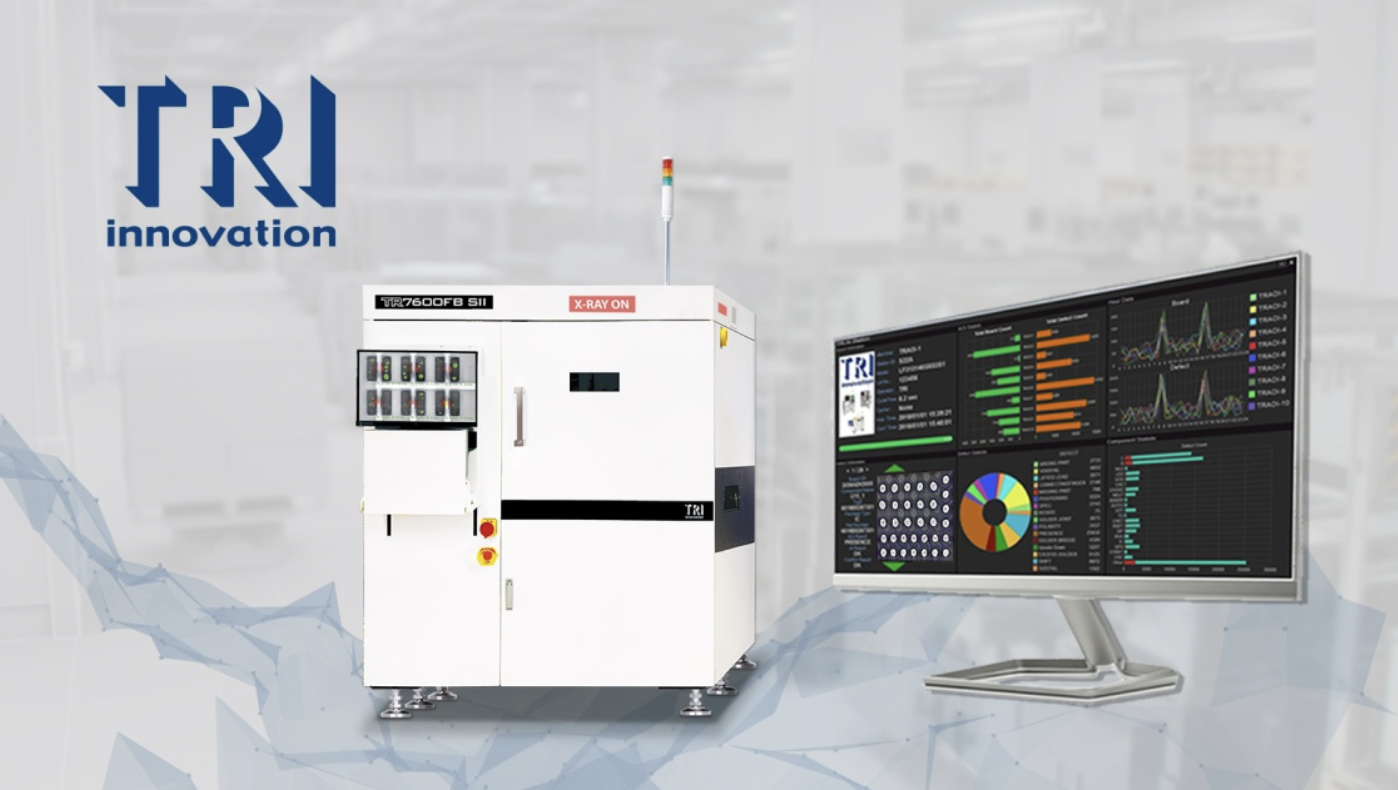
To facilitate this advanced decision making, the AI Verify Host features a comprehensive operator dashboard designed for absolute clarity. The interface provides real-time Board Information and Defect Statistics across multiple connected inspection machines simultaneously. Operators can monitor Hourly Data trends for both board production and defect rates to identify production bottlenecks. When reviewing a specific anomaly, the Defect Information panel displays a direct visual comparison between the flagged component and a “Golden” standard, alongside the AI’s precise classification result. Additionally, detailed Component Statistics break down anomalies by specific package types and categorize them by Machine Defect, AI Defect, and Confirm Defect, granting production managers granular visibility into yield metrics.
The Strategic Advantage of AI Fine Tuning
While the initial integration of AI models provides a strong foundation, the true potential of an intelligent inspection system is unlocked through AI Fine Tuning. Distinct from training the overarching neural network, AI Fine Tuning focuses on automatically adjusting specific inspection parameters within the AXI programming. This process continuously optimizes physical machine settings to ensure the hardware captures the highest quality data for the AI to analyze.
The implementation of AI Fine Tuning fundamentally shifts the role of the operator from a manual adjuster to a strategic overseer. A primary advantage is its ability to drastically reduce both programming time and false call rates, effectively leveling the playing field between personnel. Traditionally, achieving an optimized AXI program with minimal false calls required the deep expertise and intuition of a Senior Engineer. With AI Fine Tuning, a Junior Engineer can now execute complex setups in a fraction of the time, achieving the same high-accuracy, low-false-call results that once took years of experience to master. By automatically determining the best inspection parameters, the system minimizes the potential for manual setup errors and bridges the gap created by the skilled labor shortage.
Accelerated AXI Programming and Fine-Tuning Efficiency
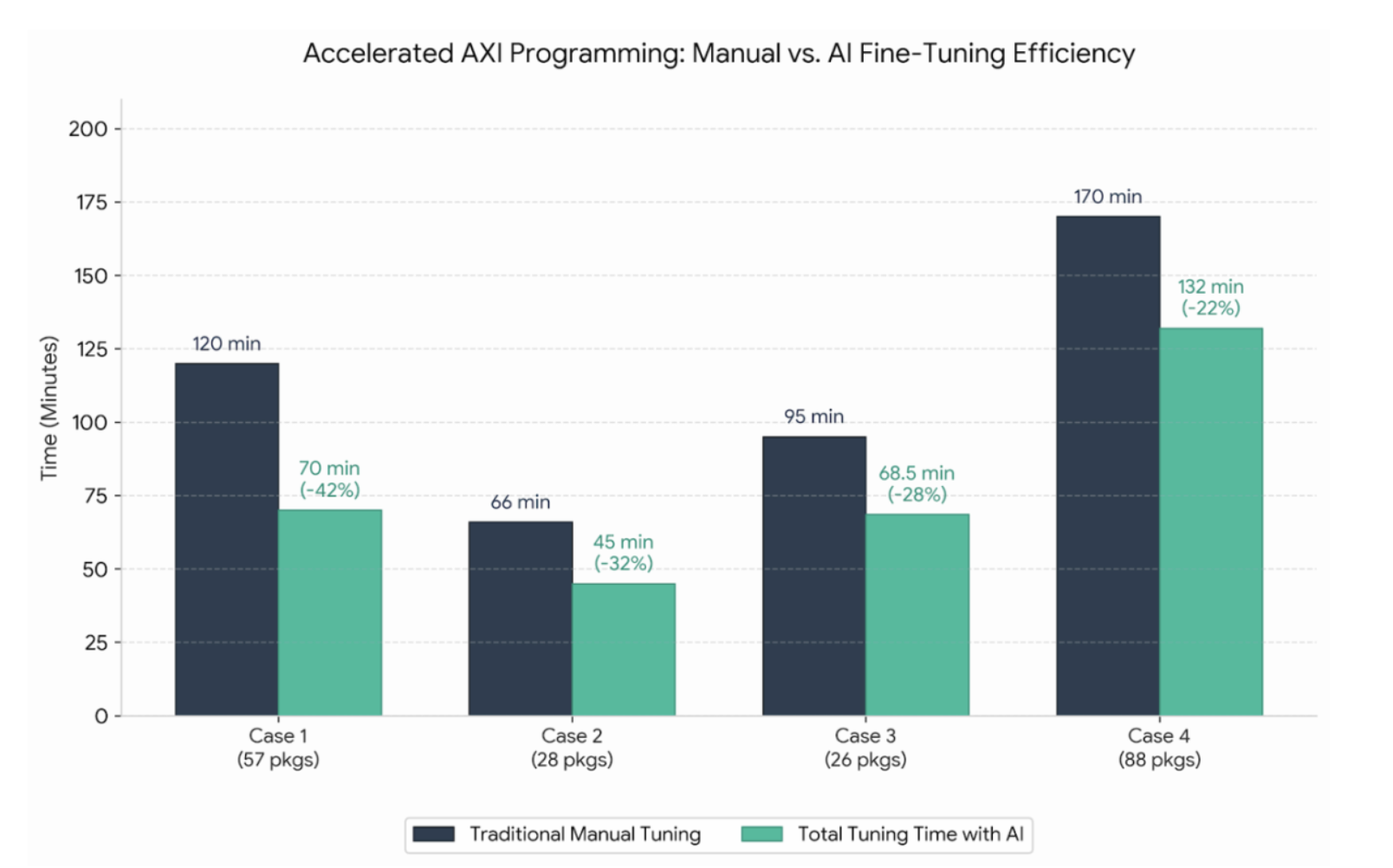 An extensive AXI case study evaluates the efficiency of AI Fine Tune across four distinct package configurations, proving significant time savings for programming teams:
· Case 1 (57 packages / 4,336 components / 26,616 pins): Traditional manual fine-tuning took 120 minutes. Implementing AI Fine Tune required only 6 minutes, bringing the total tuning time down to 70 minutes and achieving an approximate time reduction of 42%.
· Case 2 (28 packages / 76 components / 3,859 pins): Standard tuning took 66 minutes. With a 2-minute AI Fine Tune, the total time was reduced to 45 minutes, yielding a 32% time savings.
· Case 3 (26 packages / 9,695 components / 24,248 pins): The initial 95-minute manual tuning time was drastically improved. The AI process took 4.5 minutes, resulting in a total tuning time of 68.5 minutes and a 28% reduction.
· Case 4 (88 packages / 2,972 components / 15,206 pins): With a baseline tuning time of 170 minutes, utilizing a 5-minute AI Fine Tune lowered the total time to 132 minutes, providing a 22% overall time reduction.
Overcoming Implementation Barriers
Implementing AI capabilities involves critical considerations regarding data safety and cybersecurity. As organizations increasingly rely on data processing, they face the risk of cyberattacks compromising data security and privacy. To mitigate this risk, large EMS and data-conscious manufacturers often opt to install AI servers on-site, ensuring that data remains within the premises. The AI Verify Host provides exactly this type of secure, localized processing.
Furthermore, best practices for implementing AI in AXI are emerging from early adopters and industry leaders. Successful implementations typically involve cross-functional collaboration between quality control, IT, and production teams. A phased approach, starting with pilot projects and gradually expanding, allows organizations to learn and adapt effectively.
When it comes to model training, data quality is paramount. Synthetic data generated by computer simulations can supplement real-world data, reducing training time and costs. Interestingly, vendors’ requirements for model training can vary significantly, with some needing fewer than 50 images for initial training. Finally, continuous monitoring and refinement of AI models remain essential to ensure ongoing performance improvements and adaptation to new products or processes.
The Expanding AI Ecosystem
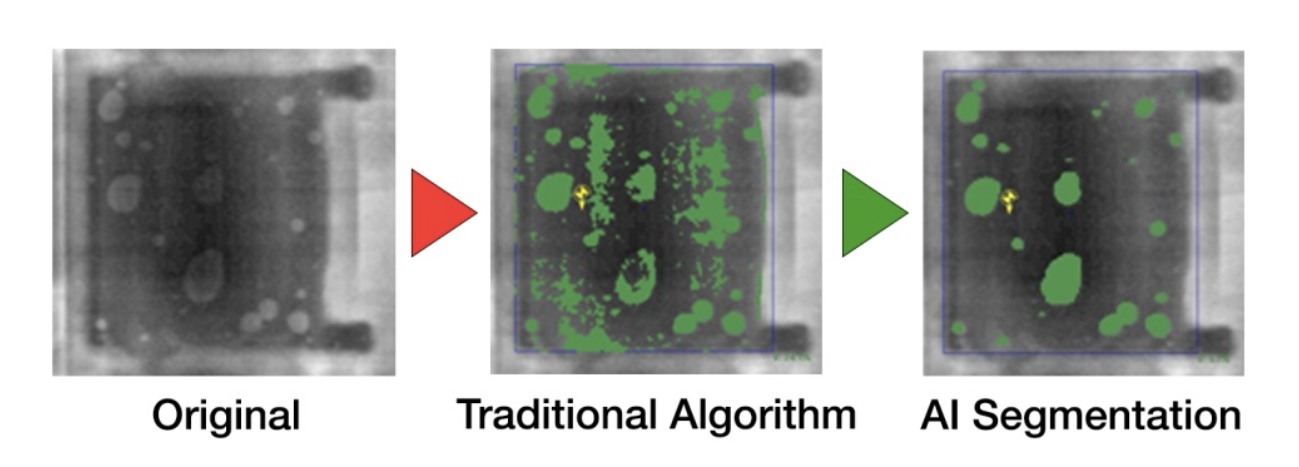 The AI Verify Host anchors a comprehensive ecosystem designed to optimize the inspection lifecycle across AXI. A key feature of this ecosystem for AXI is AI Denoising. This vital technology filters out the noise of the images. For example, if the image has a lot of noise caused by a heatsink or the contrast is very low, AI Denoising can improve the quality of the image, sharpen it, and make the defect more noticeable for the operator. The primary function is to help the operator identify the structures and defects with higher quality images directly from the Repair Station to do better Buy-off.
Conclusion
I Integrating AI-driven inspection represents a new frontier in quality control, enabling manufacturers to keep pace with the increasing complexity of modern electronics. The transition to a multi-model AI architecture is not merely a theoretical upgrade; it is a proven operational necessity. By automating parameter optimization and defect judgment, facilities are currently cutting false calls by up to 88%, keeping escape rates as low as 0.05% in active production scenarios, and achieving up to 98% classification accuracy on complex multi-layer BGAs.
The industry must embrace this technology, investing in cross-functional collaboration and pilot programs to fully realize its potential against the ongoing labor shortage. As the technology evolves, we can expect even more sophisticated applications, integrating AI with augmented reality and advanced robotics to fully automate rework. Those who master this technology will be well-positioned to deliver higher-quality products, respond more quickly to market demands, and operate more efficiently than ever before.
About Test Research, Inc. (TRI)
TRI offers the most robust product portfolio in the industry for Automatic Test and Inspection solutions. From Solder Paste Inspection (SPI), Automated Optical Inspection (AOI), and 3D Automated X-ray Inspection (AXI) systems to Manufacturing Defect Analyzers (MDAs) and In-Circuit Test equipment, TRI provides the most cost-effective solutions to meet a comprehensive range of manufacturing Test and Inspection requirements. Learn more at www.tri.com.tw. For sales and service information, please write to us at marketing@tri.com.tw or call +886-2-2832 8918.