
Production Powerhouses Series – XLR8 EMS & Boann Garry
XLR8 Scales High-Reliability Production with 10th SMT Line, Unified Workflows
 XLR8, a leading Electronics Manufacturing Services (EMS) provider for the aerospace, defense, and medical sectors, has successfully integrated its 10th surface-mount technology (SMT) line and expanded its San Clemente facility. The strategic investment significantly increases overall capacity across both the San Clemente and San Diego sites while enabling enhanced process control and production agility for complex, high-reliability assemblies.
In a recent interview, Boann Garry, a key operations leader at XLR8, detailed how the expansion provides substantial headroom for growth while harmonizing production workflows and driving continuous improvement through advanced inspection technologies and digital transformation.
Expanding Capacity for Future Demand
Garry emphasized that the 10th line was a proactive investment designed to stay ahead of anticipated market growth. The expanded footprint ensures XLR8 is well-positioned to scale production without near-term capital constraints.
“The 10th line was really an expansion way ahead of the demand,” said Garry. “At the present time, we have plenty of capacity. We’re running on one shift plus a partial second shift. There’s lots of room for expansion on both first shift and second in both sites.”
Harmonizing Operations Across Two Sites
Beyond physical capacity, XLR8 prioritized operational and cultural integration between its San Clemente and San Diego facilities, which historically operated as independent, family-owned organizations. The company standardized workflows through unified ERP and manufacturing execution systems (MES) while implementing shared core values and mission statements across both locations.
“The harmonization began way before the investment of the last line we bought,” Garry explained. “It started with ERP systems, MES systems, and when I came to the company a year and a half ago, I really worked on processes and procedures to ensure that both sites are following the exact same workflows.”
 She highlighted the importance of cultural unification, noting that employee events, combined Town Hall meetings, and a shared vision statement have helped bridge differences. “I feel like we’ve come a long way,” she said. “People know each other, and we’ve instituted core values and mission and vision statements that have been shared across multiple Town Hall meetings.”
Data-Driven Process Control for Defect Reduction
XLR8 has deployed end-to-end 3D solder paste inspection (SPI), automated optical inspection (AOI), and automated X-ray inspection (AXI) across its lines. The company leverages data from these systems to create a closed-loop feedback mechanism that drives real-time process adjustments—from solder printing to placement programming.
“We’re taking the data from all the inspection stations and feeding it back through the process to improve solder printing, to improve the placement program, and to improve QA steps in advance,” Garry said. “It’s definitely an iterative process. You have to keep at it constantly, especially when the product we’re making is not the same product over and over again. It’s different product week in, week out, which means you’re going to start possibly with a higher defect rate, and then you’ll work it down over time.”
The company has achieved a 95% first-pass yield (FPY) target at final inspection for its most complex programs and uses a DMAIC (Define, Measure, Analyze, Improve, Control) framework to systematically reduce defects.
“Continuous improvement is a continuous loop,” Garry noted. “You look at what your top offenders are on a weekly basis. You don’t try to boil the ocean – you attack those top offenders, and once those have been reduced, then you move on to the next ones.”
Tackling the Challenges of Miniaturization
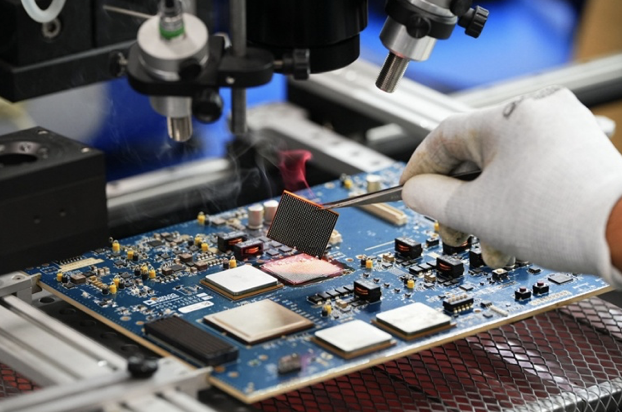
Wafer-scale packaging (WSP) represents XLR8’s most challenging board type, with increasingly tight component spacing that leaves minimal margin for error in printing and reflow processes.
“The most challenging by far is wafer-scale packaging, where the densities on the board are tighter and tighter, so there’s less component spacing between those parts,” Garry explained. “You don’t have any margin for error on printing and reflow.”
To address this, XLR8’s process engineering team has adopted advanced stencil technologies. “The technology the team is using is nano-coated stencils. The stencils are laser-cut, hexagonal, and then nano-coated to help with the release. When you get smaller and smaller component apertures, there is an issue with getting the solder to release through that aperture when you print. That’s why you have to go to newer technologies and more advanced processes to ensure that you get the right amount of solder on the pad.”
Digital Transformation and the Role of AI
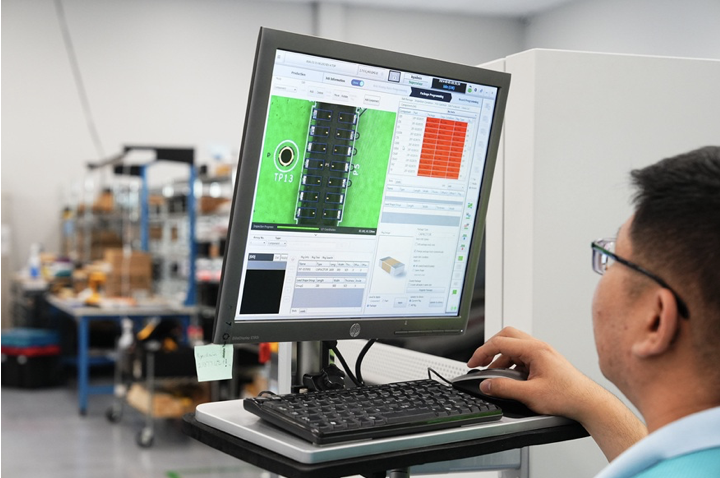 While XLR8 has not yet deployed AI-driven systems for production processes, the company has already realized significant efficiencies through its new Valor software suite, which standardizes customer Gerber data for DFM checks and direct machine programming.
“Valor takes the standardized Gerber output from the customer’s files,” Garry said. “It not only allows us to do design for manufacturability checks, but it also pushes the programming data to each of our machines. It has been a game changer.”
Garry sees AI’s most immediate impact in streamlining support functions. “Where I see AI helping us the most in the remainder of the factory is in terms of producing work instructions, strengthening our current QMS system, and advancing certain offline systems. AI is really helping us get that done quickly.”
Uncompromising Traceability for High-Reliability Programs
For aerospace and defense customers, XLR8 maintains rigorous lot-level traceability and component pedigree tracking. The company procures parts exclusively through franchise distributors who purchase directly from OEMs, ensuring a verified chain of custody.
“We only allow purchasing of components through franchise distributors, and the franchise distributors only buy from the OEM,” Garry explained. “Those documents are retained on receipt. When the part arrives, we scan the receiving documents into the system, and that ties to a unique barcode that we put on the parts themselves.”
That barcode travels with components throughout the factory, enabling comprehensive tracking through SMT equipment and final assembly. “At the end of the day, we can output a full DHR (Device History Record), including the manufacturer lot code, date code information, and all the operations that the product went through. Every board is serialized, so you get down to the actual PCB unit level on traceability.”
Balancing Rapid Prototyping and Production
XLR8 differentiates its approach between rapid-turn prototyping and full-scale production, scaling planning and validation efforts accordingly. Rapid-turn projects – capable of being completed in as little as three days – prioritize speed and may involve some rework, while production runs undergo comprehensive Manufacturing Readiness Reviews (MRRs).
“On a rapid-turn project, there are certain pieces of planning and validation that you don’t do because you don’t have time,” Garry noted. “We’re going to make sure it’s built correctly per your documentation, but we won’t have time to do things like perfect the reflow profile or perfect stencil design. We may end up building ten pieces and have some rework in the process.”
For production, the approach is markedly different. “We’re heavily weighted on doing manufacturing readiness reviews, we call them MRRs,” Garry said. “Our whole team – quality, manufacturing, engineering, and program managers – all review the documents with their own lens. If there’s a note on the drawing that says it ‘must comply with XYZ standard,’ the quality person is asking, ‘How are we going to comply?’ We expect that all the lessons learned are in the rearview mirror, and we expect to get very high yields, like 98% on the outcome.”
Real-Time Visibility Through MES
 XLR8’s MES provides real-time visibility into production status for both customers and internal stakeholders. The system tracks serial numbers through each station, allowing engineers to define product routes and operators to scan boards throughout the process.
“Before you run the product, the engineer sets up the product route, so they’ll tell you all the stations that product has to travel through,” Garry explained. “As operations follow that route and scan the board all the way through, at any given point in time – like right now – I can run a report to see where all my WIP [work in progress] is in the process.”
About XLR8 EMS
XLR8 EMS is a high-performance electronics manufacturing partner specializing in advanced PCB assembly, rapid prototyping, and full-scale production for the aerospace, defense, medical, and industrial sectors. Recognized for its speed, precision, and rigorous quality standards, the company delivers end-to-end solutions backed by complete traceability and responsive engineering support. For more information, visit www.xlr8ems.com